


The essence of architectural work - Part 9
Software development approaches in-depth and the system lifecycle

The essence of architectural work - Part 9
In the previous post, we defined the certainty-uncertainty continuum and placed widespread software development approaches along the axis the continuum spans.
In this post, we will use some project examples to clarify further which approach is best for what type of task. Then, we will add the solution lifecycle dimension and its impact on architectural work. Finally, we will use the two dimensions to lay out what to do When and How much to do regarding architectural work.
Typical project types
Some people see very different types of IT projects over the course of their careers. Others may see the same types over and over again, depending on the companies and contexts they work in. I collected a few more or less representative types of projects along the certainty-uncertainty axis that may help you to understand better in which section of the axis you typically work. 1
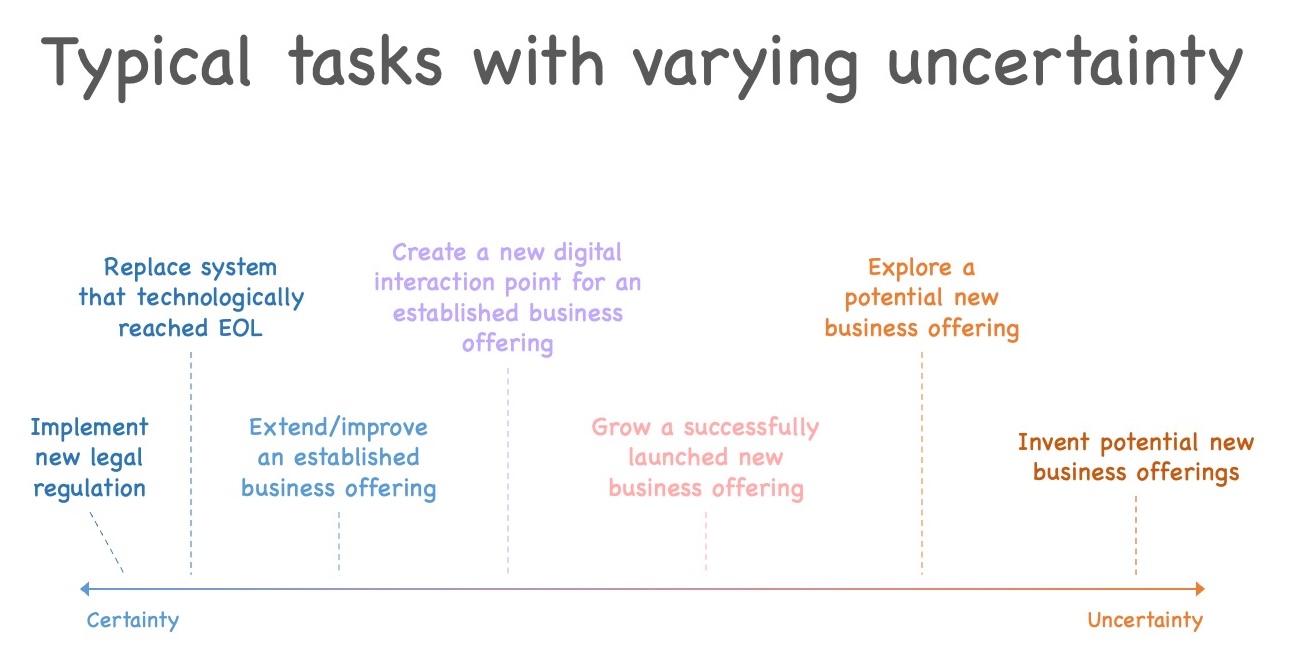
Moving from perfect certainty to complete uncertainty, we find the following project types:
- Implement a new legal regulation into the existing systems, e.g., a new customer documentation law in banking. There is not any external uncertainty involved. We do not need any market feedback loops to understand which solution to implement. It is only existing systems and a legal requirement. We may not know yet which systems we need to touch where because we lack proper system documentation. We may not know exactly what the legislator requires us to do in detail. But all this can be clarified upfront before we start to implement the changes.
- Replace a system that has reached its EOL (end of lifecycle). Replacing systems that went EOL with new systems rarely gets done without changing the existing business logic at all. However, if we manage to contain the changes to a limited list of minor improvements regarding usability, there is still very little uncertainty involved. The old system is in place. We can see what it does and how it does it. We can read the source code and all existing documentation. Most of the required improvements are known upfront. I.e., besides a few improvements that may benefit from feedback cycles, everything can be clarified upfront.
- Extend or improve an established business offering, e.g., a new tariff plan generation in telecommunications. Most of the required business logic is in place. A bit of new functionality needs to be added and integrated sensibly into the existing system. That adds a certain level of uncertainty, which requires a bit of back and forth with the users to maximize user acceptance and thus business value. Still, the amount of uncertainty is manageable.
- Create a new digital interaction point for an established business offering, e.g., a subcontractor self-service app in logistics. While we know the business, we do not yet know how to digitize it best. Turning an existing manual process into a digital one adds quite a bit of uncertainty. We do not know yet which interaction patterns work well and which do not. How do we present the information best? How do we guide the user? And so on. We will need quite a bit of user feedback along the way to implement a successful solution.
- Grow a successfully launched new business offering. E.g., insurance companies started expanding their business from just selling insurance policies to offering hassle-free safety in their customers’ “lifeworlds”, like mobility, living, or health. This goes way beyond the traditional business models of the companies. They create whole new business-level platforms. They leave their core domain. They need to find completely new interaction forms with their business partners. And most importantly, they need to understand what their customers actually want and are willing to pay for. This is a lot of uncertainty, and it involves many feedback loops to uncover new successful offerings.
- Explore a potential new business offering. This is what startups do in their very early phases, and what quite a few established companies try to do in their “innovation labs”. We have a new business idea. We have not started its implementation yet. We do not know yet if we will meet a need and attract enough customers who are willing to pay for our offering. We have not yet found the highly desired product-market fit. Uncertainty is extremely high, and we are in a state of experimentation. We do a bit. We ship. We listen. We learn. We adapt – or pivot. Rinse and repeat. As fast as possible. Our only chance for success is fast feedback loops.
- Invent potential new business offerings. E.g., we have the vision of “creating a better world for our children”, but we do not yet know how a potential business offering could look like that matches the vision. Full and utter uncertainty. We do not even know what we should start implementing. We have nothing but a vision.
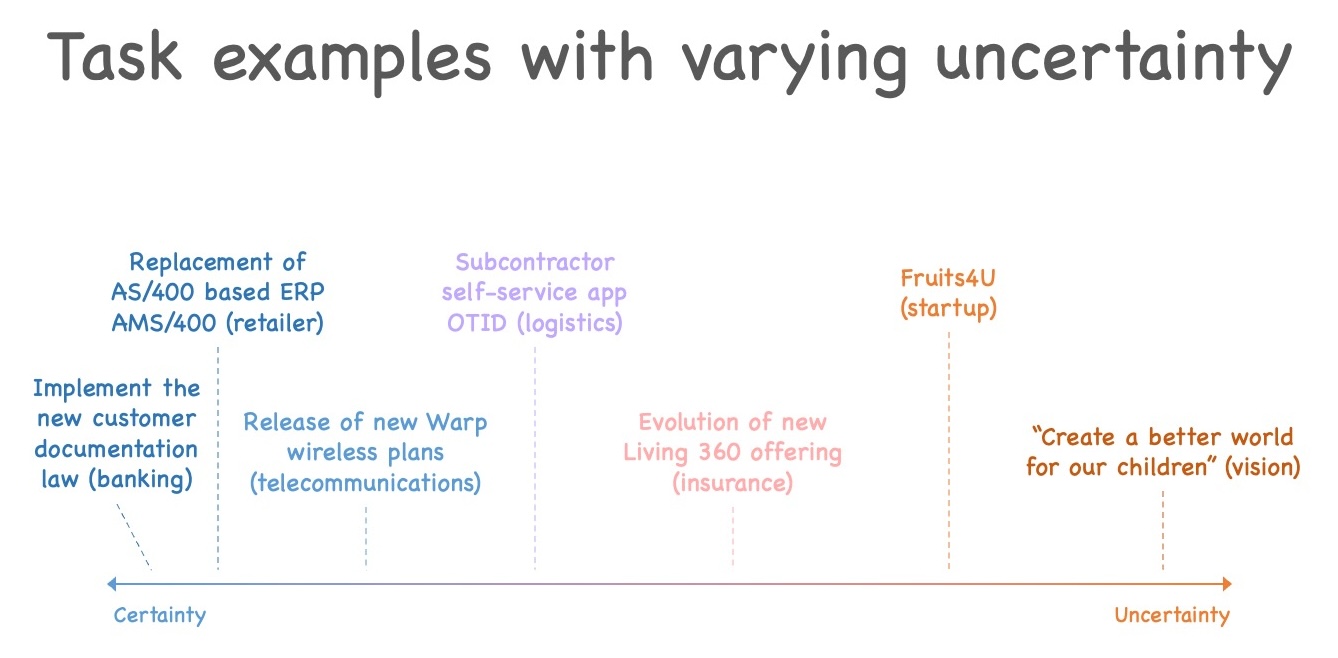
In my workshops, I also added some concrete project examples where suitable to make the project types even more comprehensible:
- A bank implements the DIRECTIVE (EU) 2023/2225 OF THE EUROPEAN PARLIAMENT AND OF THE COUNCIL of 18 October 2023 on credit agreements for consumers. Of course, nobody implements the directive immediately. Instead, it is translated into country law, usually including implementation information. Everyone implementing banking-related software knows these kinds of projects.
- A retailer needs to replace its ERP solution AMS/400 (“Article Management System”) because the support for the product is discontinued, and required new features will not be implemented by the vendor. The new solution will be a custom implementation running on Linux-based servers because the company also wants to replace the AS/400 over the next 5 years.
- A telecommunication company is going to release its new WARP wireless tariff plans that not only offer more data volume but also introduce some nice additional features (I leave it to your imagination what these features are).
- A logistics company plans to digitize its currently still manual subcontractor processes. Therefore, they plan to build a new mobile app called OTID (Order picking, Tour planning, Inquiry, Delivery documentation) they will provide their subcontractors for smoother delivery planning and execution.
- An insurance company wants to expand their recently launched Living 360 offering. After initially providing quick repair support in case of damage, they additionally plan to offer finding flats and houses more easily, including handling of required renovation and conversion works.
- A startup has a new business idea, Fruits4U, that supports their customers in a healthier and more balanced diet that fits their lifestyle. They also want to include gamification features in their app, and they want to organize the delivery of the food in a way that the customer only needs to eat it.
- A builder wants to create a better world for our children. While being fervently motivated to deliver to this desirable vision, the builder does not know yet what to build. The vision offers a plethora of options, and picking one that not only aligns with the vision but also has the chance of attracting customers who are willing to pay for it still feels overwhelming.
As we can easily see, there is not a single development approach that suits all those project types and examples. We need several approaches depending on which type of task and associated uncertainty we want to address.
Side note: Most companies, I have seen, only think in the first 3 project types, rarely in the 4th one, and basically never in the 5th one 2. That is one of the reasons why enterprise “Agile” is so non-agile. Most companies are poorly set up to deal with external uncertainty.
Mapping project types to software development approaches
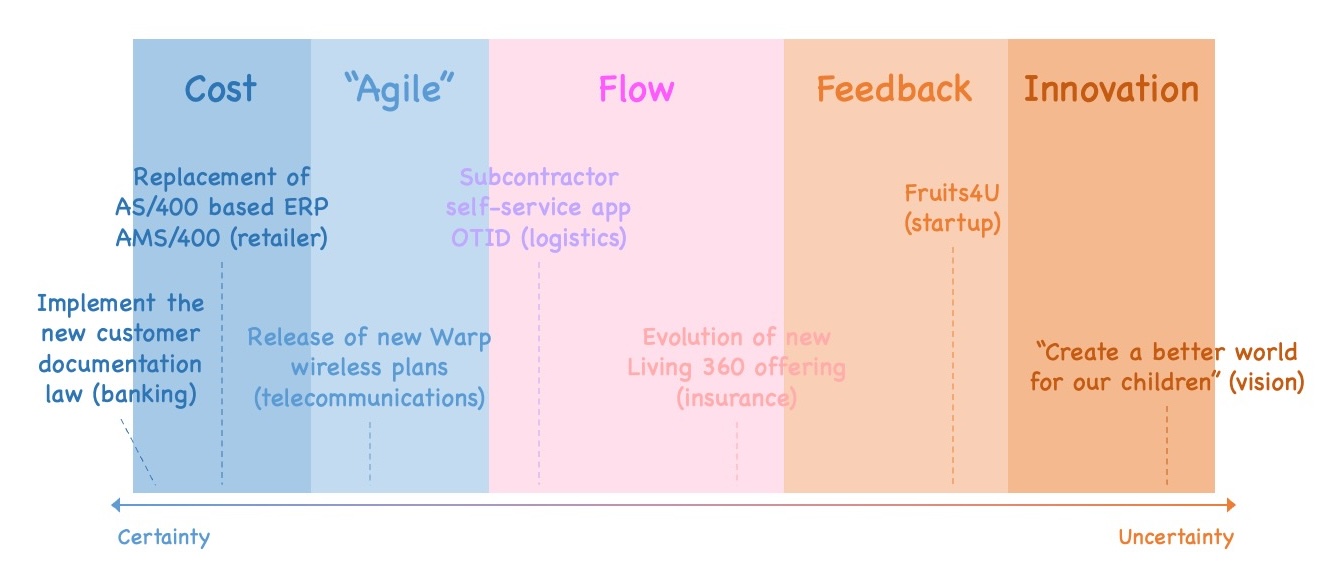
If we take the software development examples of the previous post and overlay them with the project examples just discussed, we get the image shown above. In that image, we can clearly see which approach is most suitable for which project type:
- Implementing the European directive on credit agreements for consumers as well as replacing the ERP solution AMS/400 are both best approached with a Cost method. Uncertainty is small enough in both cases.
- The new WARP wireless tariff plans are implemented best using an enterprise “Agile” approach. We have a bit of uncertainty, but we are still on our home turf.
- Building the new mobile app OTID and expanding the Living 360 offering both call for a flow-based approach. We face a decent amount of uncertainty and need to make sure that our approach can deal with it appropriately.
- The startup will most likely pick a feedback-based approach for their new business idea, Fruits4U. There is so much uncertainty that we need something that leans even more towards uncertainty than flow-based approaches.
- Finally, the builder who wants to create a better world for our children focuses on innovation.
The impact of the system lifecycle
But how are the four activities of the 4E framework organized in the different software development approaches?
We need to cover one last aspect before we can finally answer this question. The missing aspect is time, i.e., the lifecycle of a system. Quite often, architectural work is reduced to creating a new system. However, the work is not done after the initial release of a system. We need to expand and reevaluate our architecture regularly.
When dealing with a lot of uncertainty, our architecture is not complete after the initial release, anyway. It grows and changes over time.
But also if we do not face a lot of uncertainty, we need to reassess our architecture regularly. A changing problem domain, i.e., changing context and conditions, can invalidate previously valid architecture decisions, and we need to adapt the system to the new constraints. E.g., the system was initially designed for internal use only. Eventually, it was also opened for end user access, which changed the request numbers massively, and the system would not be able to handle the increased load if left unchanged. If we do not capture these changes in our architecture, our solution will not match the needs and demands it is meant to implement.
We will also experience implementation drift over time. I.e., successive implementation changes will accumulate as (small) deviations from the architecture and eventually violate the architectural constraints. E.g., a series of changes may increase the response times, and eventually the response time violates the contract agreed upon (like, e.g., a response within 500 ms for 99% of all requests).
We can only respond to such adaptation needs if we assess the system once in a while: Have the conditions changed? Are upcoming changes already known? How do they affect the architecture? Do we need to change the architecture to meet the new constraints? Does the current implementation match the existing architecture constraints? Is there some implementation drift we need to contain? And so on.
Such a reassessment consists of all 4 activities of the 4E model. Depending on the scope and frequency of the reassessments, they are executed as quite heavyweight or lightweight, considering the whole architecture or assessing parts of it only. No matter how it is done, you will usually find all 4 activities during a reassessment.
This emphasizes that the activities of the 4E model define the What of architectural work, but they do not define the When and How much. We tend to find all four activities time and again over the lifecycle of a system.
As written at the end of the post discussing the What, we also cannot assume a clear order of the activities. While there are causal dependencies between the activities, we should expect jumping forth and back between them due to feedback cycles involved. E.g., when communicating our ideas to a stakeholder (Execute), we may learn something that lets us revisit our design (Explore), which in turn may affect the tradeoffs (Evaluate). And so on.
To sum up this section: To deliver to the Why of architecture, it is not enough to do the architectural work only once. We need to do it across the whole lifecycle.
Interlude
In this post, we discussed several project examples to clarify further which approach is best for what type of task. We also discussed the solution lifecycle dimension and why we need to take it into account for architectural work.
Having all this preparation work done, we are finally ready to lay out what to do When and How much to do regarding architectural work in the next post (link will follow). Stay tuned … ;)
-
I used the project types in a former post discussing degrees of uncertainty. Here, we revisit them and dive a bit deeper into them for a better understanding. ↩︎
-
I am still waiting for an insurance company actually expanding their offerings in the way I sketched here. ↩︎

Share this post
Twitter
Reddit
LinkedIn
Email